|
January
Winter Meeting
2nd Sunday in January
|
April
Spring Meeting
Sunday
4/12/2026, 2:00 PM
|
July
Summer Meeting
Sunday
7/12/2026, 2:00 PM
|
October
Fall Meeting
Sunday
10/11/2026, 2:00 PM
|
| |
|
|
|
Clanton
|
Brief History of Clanton
Early Settler Days
Originally, the locality of Clanton was a cattle ranch
and apparently a destination for waterfowl hunting...
the main creek through the area of the future town was
called Goose Pond and the area just a mile or two
eastward was called Ranch.
The Williams family owned all of this area and used it
for a cattle ranch. Their son and Alfred Baker soon
took over the property in the Clanton area and
Baker quickly bought out all the Williams'
interests.
Alfred Baker
Alfred Baker's family had moved to this area when he
was an infant. By the 1860s he was a Legislator from
Autauga County in Montgomery, apparently as part of the
"Radical Republicans" that were in charge during
Reconstruction.
In 1868 Baker was instrumental in convincing the
Legislature to create the new county of "Baker" from
parts of Autauga, Shelby, Bibb, Perry, and Dallas.
About this same time, Baker had bought large amounts of
property in the center area of this new county.
Baker soon had the town surveyed and laid out. He gave
lots (or sold them for one dollar) to churchs and
government organizations.
After a few years Baker fell out of favor, likely
because of some personal indiscretions and his
politics. He moved westward for several years and
ultimately returned to Clanton shortly before his
death.
Early Years
Ranch / Goose Pond
Until the formation of Baker County in December 1868,
the area had two notable communities, Goose Pond and
Ranch, separated by a couple of miles. Albert Baker
owned significant parts of all the property of those
communities and in-between, especially the Goose Pond
area. Mentions of Goose Pond have been found as early
as 1843 in Autauga County newspapers, discussing election
returns for that voting place. The Goose Pond Post Office
was created in January 1871 by Alfred Baker, but it was
changed to Clanton by May. The Ranch Post Office apparently
only existed in about the same 1871 timeframe.
Gullahorn's Switch
In the 1870 timeframe, the Gullahorns owned a lot of
propety and operated a sawmill where downtown Clanton
is today. Apparently for a time the railroad location
was called "Gullahorn's Switch."
Baker's
In the 1871 Alabama Legislature draft of the law
setting up times for a new courthouse location
election, Clanton is first called "Baker's." This is
the only mention of this name found thus far.
Clanton Station
In the same Legislative draft, Clanton Station is
mentioned. The railroad named their stations after
their friends and supporters in Montgomrey -
legislators and wealthy businessman. Clanton Station
was named after James Holt Clanton. It was mentioned
that the county papers were being stored there in the
station.
Clanton
Before the 1871 document became law, it was amended
such that the name Baker's was changed to Clanton.
Clanton was first incorporated in April 1873, but that
was later repealed. It was again incorporated in
February 1897.
Baker County
Baker County's county seat was named "Grantville" which was
effectively at the location of the former "Ranch"
mentioned above. This was at a crossroads, today near
I65, where a north-south road came from Montgomery
toward Montevallo and an east-west road went from
roughly Columbiana toward Maplesville. This courthose
was very shortlived and burned less than a year - in
spring 1870.
In February 1871 the Alabama Legislature passed a law for Baker
County to have an election April 1st for a new courthouse
location. Those communities in the running were
Clanton (at first called "Baker's" in the documents),
Barrett's (Verbena), Benson (Isabella), and Lomax.
Clanton and Benson went to a runoff on April 29th and
Clanton won to become the new county seat. On May 2nd
the county commissioners declared Clanton the new county
seat.
Courthouses
Baker County's first courthouse was built at Ranch,
renamed Grantville, in 1869. It was operational until
March of 1870 when it burned. Tradition has that it
was built of logs, however, many contemporary newspaper
articles describe it as frame.
The first courthouse in Clanton was built in 1872 and
was a two story wood frame structure that sat in the
middle of the intersection of 2nd Avenue North and 6th
Street and faced the railroad. Practically all of the
businesses at that time were located on the strip of
2nd Avenue North from the courthouse to the railroad
and just beyond.
When the county decided to build a new courthouse in
1896, the original courthouse was moved (by a mule)
from the intersection just a few yards down 2nd Avenue
and continued to be used as a store for many years.
The new 1896 courthouse was a brick structure, two
stories, with a tower. Many of the ca 1900 photographs
of downtown Clanton were made from this tower. The new
courthouse location was changed from the center of the
intersection to the northeast corner of the
intersection.
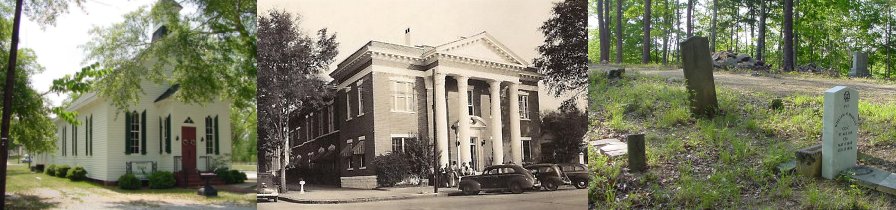
This courthouse partially burned in 1918. Large parts
of the structure were reused in the new courthouse that
was built after the fire. The front of the new courthouse
was different and was built with large columns.
The 1918 courthouse was replaced in 1962 by a new
building. All the property from 6th St. to 5th St. was
purchased and the new structure was built in the middle
of the block - while the old building was still in use.
When the new courthouse was completed, the old one was torn
down.
Today (2026) the county has almost completed the next
courthouse on Hwy 145 and should move in the spring.
1880 descriptoins - DeJarnette
A couple of descriptions of Clanton about 10 years
after the County formation by African-American Minister
Peter DeJarnette, Sr. were printed in the Union Banner
in 1934 and 1938. He was working for Gullahorn’s
sawmill in Clanton around 1880 and describes it
thusly:
John Gullahorn’s sawmill was about the only thing in
the new town. The sawmill was behind the location of
the Big Four Hardware Company (southwest corner of 2nd
Avenue North and 7th Street). The area was sometimes
called Gullahorn’s Switch. The roads were “nothing more
nor less than a real rough route, with stumps,
treetops, logs and holes.” There was a log Courthouse,
log jail, and a Commissary near where City Hall stands.
The train “depot” was a boxcar where train tickets were
sold. He helped unload the first train carload of
fertilizer that came to the area and they had to keep
the buzzards knocked off of the bags! When he worked
for the Sloss Mineral Company he was robbed of $85 and
he credited Sheriff Homer Lowe and Judge Callen
for catching and punishing the thief. He
remembered Verbena being named by Major Norton.
On a personal note, he was a Reverend, and said that,
at age 76, he had preached for 49 years, baptized 3549
people, buried 2374, married 840 couples and had
preached in nearly every prison in Alabama and in lots
of the jail houses. Some brief research on his history
shows that he was born in January, 1859 in Autauga
County, Alabama. Note that since this was before
Chilton’s existence he could very well have been born
in the area of Autauga that became Chilton. In 1870 he
is listed in the Kingston post office area with his
family, possibly father or grandfather Zacharia
DeJarnette, mother Mary A., and brothers John and
Zacharia. Ten years later he is living by himself in
Pine Flat and working as a laborer. By 1900 he is
living in Cooper, west of the L & N Railroad, married
to Ellen (1883) and is a farmer. She is listed as
having 3 children, all living, John W. (15), James M.
(13), and Peter H. (11). In 1934 Mr. DeJarnette said he
had owned his home-place for 51 years. He bought it
from the Smith, Taft, & Marbury Lumber Company, near
Marbury station.
Clanton ca. 1880-1900
The town of Clanton really began to take form in the 20
or so years before the turn of the 20th Century. The
focus of the business activity was the railroad
intersection with Main Street (2nd Avenue North). The
buildings were all wood frame at first and around 1900,
after two major fires in 1901,
some brick structures began to be built.
The only hotel
for a time was the Thornton House on the northwest
corner of 2nd Avenue North and 8th Street. A
new brick courthouse was built in 1896 and the
old wood frame courthouse, built in 1872, was
moved across 2nd Avenue and used as a store. W.
L. Sampey, merchant, built his two story brick
building on the southwest corner of 2nd Avenue
North and 7th Street. It was soon purchased by his
son-in-law Pinckard as the Pinckard Hardware store.
Clanton ca. 1900-1920
Telephone (Telegraph)
- 1898 – by the end of 1898 there was telephone service in Clanton by the American Telephone Company.
- 1906 – Southern Bell Telephone came into Clanton. Peoples Telephone Company soon followed.
Major Fires
- 1901 saw two devastating fires that reshaped the city. The old wooden framed buildings were almost completely replaced with brick and stone buildings.
- On January 31, 1914 a major fire destroyed the Palmer Hotel, the old/original Episcopal Church, and the Davis Boarding House on the top of hill on the west side of the railroad.
- 1920 the Wade Ice Plant was totally destroyed by fire in September, threatening the entire rest of the block beside the railroad on the north side of 2nd Avenue North.
Civic Progress
Progress was made in 1908
- Sidewalks were paved.
- The "frog pond" between 6th and 7th Streets and 2nd and 4th Avenues North was drained in June.
- Finally when 3rd Avenue North was extended to the railroad in 1929 the extra dirt was used to complete the filling in of the "frog pond."
Railroad
- Completed ca 1871
- Straightened the "cut" with a steam shovel June 1902.
- Built the "overhead bridge" (wooden original version) in February 1906.
|
|
|